TWO:Any action that is not included between the two above-indicated extremes can only be called a crime or punished as such by those who find their interest in so calling it. The uncertainty of these limits has produced in different nations a system of ethics contrary to the system of laws, has produced many actual systems of laws at total variance with one another, and a quantity of laws which expose even the wisest man to the severest penalties. Consequently the words virtue and vice have become of vague and variable meaning, and from the uncertainty thus surrounding individual existence, listlessness and a fatal apathy have spread over political communities.It was by the advice of Scarlett, Lord Abinger, that he ventured to aim at the repeal of all statutes punishing mere theft with death; but, deeming it hopeless to urge their abolition all at once, he resolved to begin with that famous statute of Elizabeth which made it a capital crime to steal a handkerchief or anything else from the person of another which was of the value of a shilling. His bill to effect this[60] passed both Houses the same year it was introduced (1808), in spite of the strong opposition of the great legal dignitaries in either House. The statute was based, said Judge Burton, on the experience of two and a half centuries. The alternative punishment of transportation for seven years, said the Attorney-General, would be too short; it should be for more years than seven, if not for life. If any change of punishment were necessary, said Lord Ellenborough, it should be transportation for life.
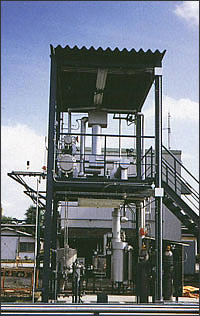
Great attention is recently being paid to global environmental issues, and it is now conceivable that companies will need to treat used solvents themselves. In consideration of this kind of social issue, we have developed a “membrane separation type solvent dehydration system,” which uses a polyimide membrane with superior dehydration properties developed by Ube Industries, Ltd. in combination with our own distillation and concentration technology that has resulted in solvents being more easily recovered.
THREE: Not only is it the general interest that crimes should not be committed, but that they should be rare in proportion to the evils they cause to society. The more opposed therefore that crimes are to the public welfare, and the more numerous the incentives to them, the stronger should be the repellent obstacles. This principle accordingly establishes the necessity of a certain proportion between crimes and punishments. If we would bring to the study of Beccaria¡¯s treatise the same disposition of mind with which he wrote it, we must enter upon the subject with the freest possible spirit of inquiry, and with a spirit of doubtfulness, undeterred in its research by authority however venerable, by custom however extended, or by time however long. It has been from too great reverence for the wisdom of antiquity that men in all ages have consigned their lives and properties to the limited learning and slight experience of generations which only lived for themselves and had no thought of binding posterity in the rules they thought suitable to their own times. Beccaria sounded the first note of that appeal from custom to reason in the dominion of law which has been, perhaps, the brightest feature in the history of modern times, and is still transforming the institutions of all countries.
- 1Under the distillation system, even in case of azeotropic solvent compositions, this system which remove water vapor by the polyimide membrane will easily dehydrate.
- 2In comparison with the distillation system, it significantly saves on use of steam.
- 3Dehydration can be performed through merely supplying evaporated vapor to the membrane module and maintaining the differential pressure between the permeable side and the impermeable side.
- 4Solvent purity of 99.9% or more can be achieved by carrying out dehydration with a polyimide membrane only.
- 5The polyimide membrane has superior heat and solvent resistance. Therefore, the vapor permeation system reduces contamination of the membrane and thus extends its life.
THREE:Another principle would serve admirably to draw still closer the important connection between a misdeed and its punishment, and that is, that the latter should as far as possible conform to the nature of the crime. This analogy facilitates marvellously the contrast that ought to exist between the impulse to[188] the crime and the counter-influence of the punishment, the one, that is, diverting the mind and guiding it to an end quite different from that to which the seductive idea of transgressing the law endeavours to lead it.
The aromatic polyimide membrane is highly permeable to water vapor but less permeable to vapors of organic compounds such as alcohol etc.
THREE:There seem to be three principal reasons why, under our present system, crime still keeps its general level, irrespective of all changes in our degrees of punishment. An error, not less common than it is contrary to the object of society¡ªthat is, to the consciousness of personal security¡ªis leaving a magistrate to be the arbitrary executor of the laws, free at his pleasure to imprison a citizen, to deprive a personal enemy of his liberty on frivolous pretexts, or to leave a friend unpunished in spite of the strongest proofs of his guilt. Imprisonment is a punishment which, unlike every other, must of necessity precede the declaration of guilt; but this distinctive character does not deprive it of the other essential of punishment, namely, that the law alone shall determine the cases under which it shall be merited. It is for the law, therefore, to point out the amount of evidence of a crime which shall justify the detention of the accused, and his subjection to examination and punishment. For such detention there may be sufficient proofs in common[133] report, in a man¡¯s flight, in a non-judicial confession, or in the confession of an accomplice; in a man¡¯s threats against or constant enmity with the person injured; in all the facts of the crime, and similar indications. But these proofs should be determined by the laws, not by the judges, whose decisions, when they are not particular applications of a general maxim in a public code, are always adverse to political liberty. The more that punishments are mitigated, that misery and hunger are banished from prisons, that pity and mercy are admitted within their iron doors, and are set above the inexorable and hardened ministers of justice, the slighter will be the evidences of guilt requisite for the legal detention of the suspected.
- 1 Recovery of the detergent solvent Recovery of the cleaning solvent such as electronic parts industry, precision instrument industry.
- 2Solvent recovery and the refinement Solvent recovery and the refinement such as chemical industry, an industry of medical supplies, food industry, the fermentation industry.
THREE:
Acetone, ethanol, methyl ethyl ketone, butanol, isopropyl alcohol, ethyl acetate, methyl isobutyl ketone, others (including hexane and toluene).
